Available for Summer 2026 / 2027 ML research internships
AI / ML PhD Candidate · Wright State University
Building trustworthy machine learning for systems that have to actually work.
PhD candidate at Wright State University, working at the intersection of adversarial ML, LLM-assisted systems, hardware security, and applied scientific ML — with 311+ Google Scholar citations across 39 peer-reviewed papers as of 2026-09-13.
Technical Profile
Applied ML, security, and systems work.
I build models and software that hold up under real constraints: noisy data, limited labels, reproducibility, adversarial conditions, and domain-specific evaluation. My strongest fit is work where ML rigor has to meet engineering reality.
See experience and skillsPythonscikit-learnPyTorchTensorFlowpandas
Experiment DesignAblationsRobustnessScientific Writing
Adversarial MLXAIHardware SecurityIoT Security
REST APIsGitLinuxDockerHPC
Featured Projects
Selected work with build and impact.
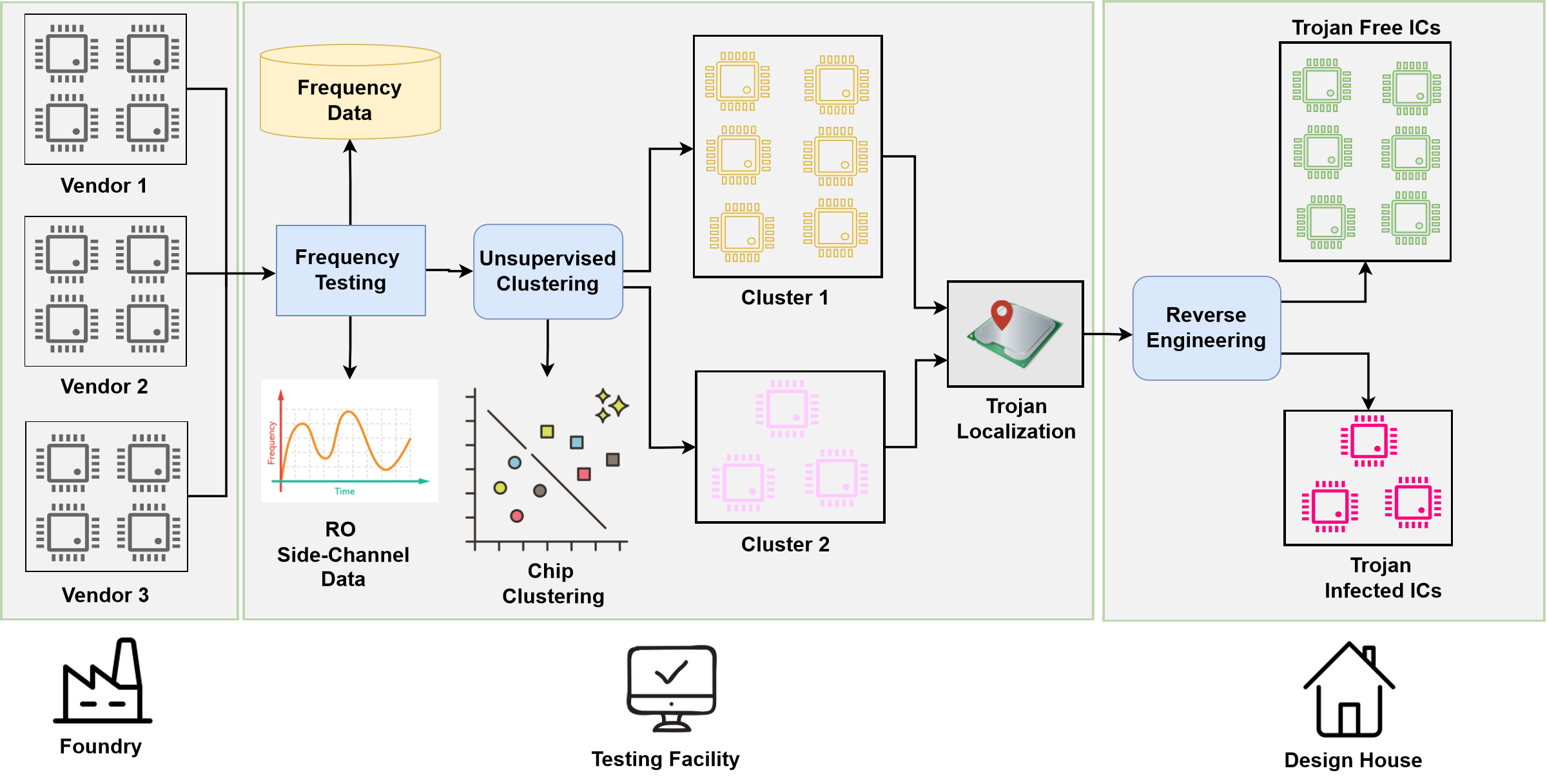
Golden-Free AI-Assisted Hardware Trojan Detection
Challenge: Traditional detection often relies on golden reference chips or destructive reverse engineering, which can be unavailable or impractical for industrial-scale validation.
Build: Built ML pipelines using side-channel data from Ring Oscillator Networks, feature extraction, unsupervised clustering, dimensionality analysis, and anomaly detection.
Impact: Published ACM JETC work contributes a golden-free unsupervised ML-assisted approach for IC hardware Trojan detection.
Pythonscikit-learnNumPypandasFPGARing Oscillator Networks

AI-Enabled Image Processing for Hardware Trojan Identification
Challenge: Stealthy IC modifications threaten semiconductor supply-chain trust, while functional testing and reverse engineering are costly to scale.
Build: Converted side-channel data into image-like representations and used image processing with unsupervised machine learning to cluster Trojan behavior.
Impact: The publisher page reports 95% hardware Trojan detection accuracy using real hardware side-channel data.
Pythonscikit-learnDSPImage ProcessingFPGA
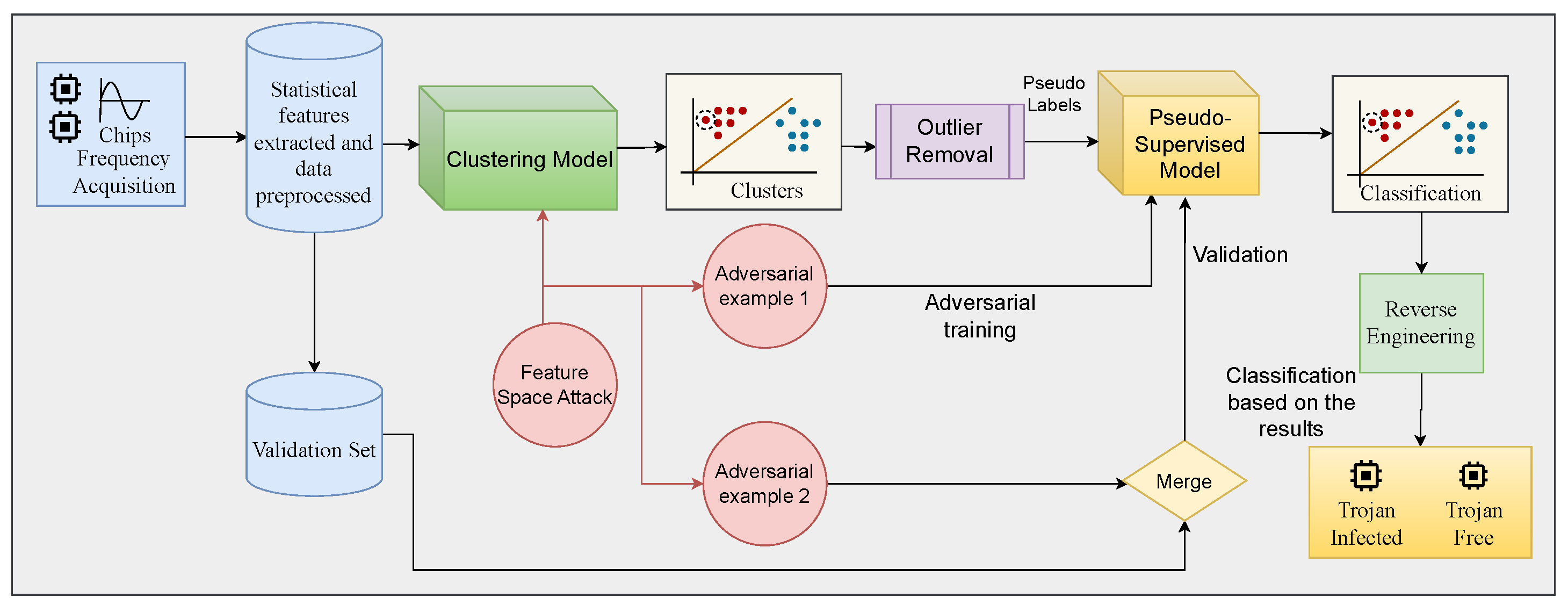
Adversarial Attack Resilient ML-Assisted Golden Free Hardware Trojan Detection
Challenge: Security models that perform well under clean conditions can fail under perturbations, process noise, or adaptive attacks.
Build: Evaluated golden-reference-free hardware Trojan detection under adversarial attack scenarios and robustness-focused model variants.
Impact: Published Microelectronics work connects adversarial robustness with practical side-channel hardware Trojan detection.
PythonARTscikit-learnAdversarial MLClusteringpandas
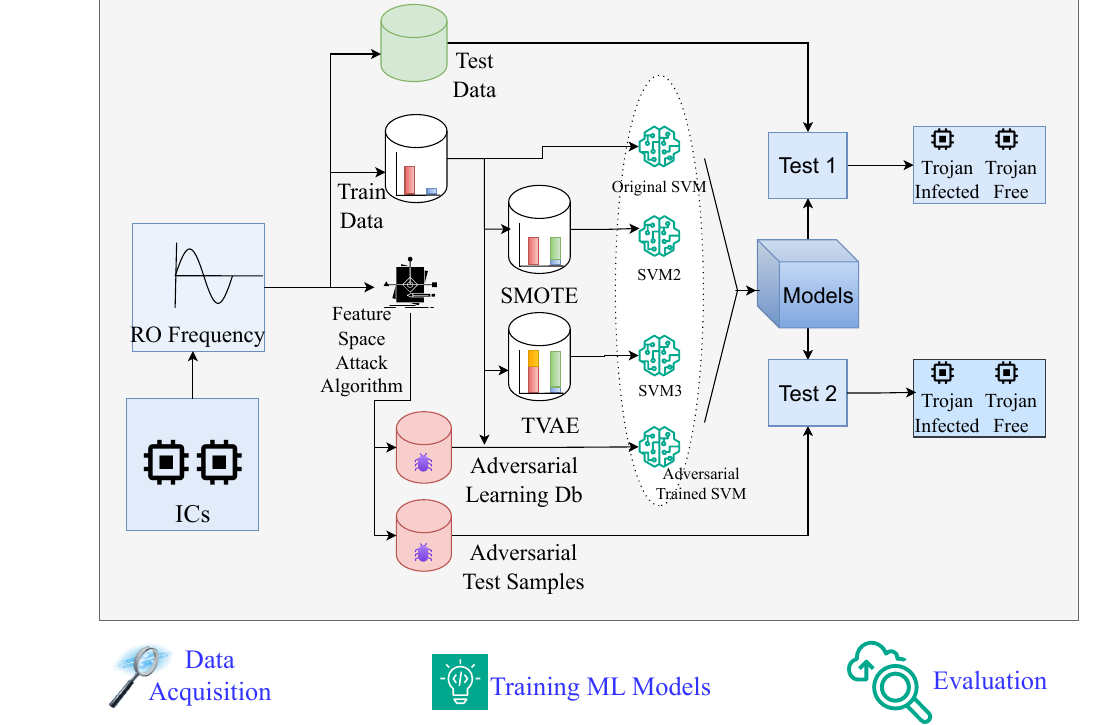
Synthetic Data Augmentation for Robust Hardware Trojan Detection
Challenge: Hardware Trojan datasets are often small, imbalanced, and vulnerable to adversarial perturbations, making robust evaluation difficult.
Build: Combined feature-space attack analysis with synthetic data augmentation and adversarially trained models for side-channel Trojan detection.
Impact: Prepared as under-submission work for Journal of Electronic Testing, extending the hardware-security research story beyond clean-data detection.
PythonSMOTETVAESVMAdversarial TrainingSide-Channel Data
Clinical Communication and LLM-Based HEART Rubric Scoring
Challenge: Medical error disclosure training needs transparent, clinically meaningful assessment of resident-patient conversations.
Build: Developed an AI-compatible HEART rubric schema with transcript-only 0-3 scoring, evidence spans, and validation planning against human ratings.
Impact: Positioned as an interdisciplinary research MVP and collaboration-ready prototype, not a deployed clinical product.
PythonPyTorchTransformersLongformerSBERTJSON Schemas
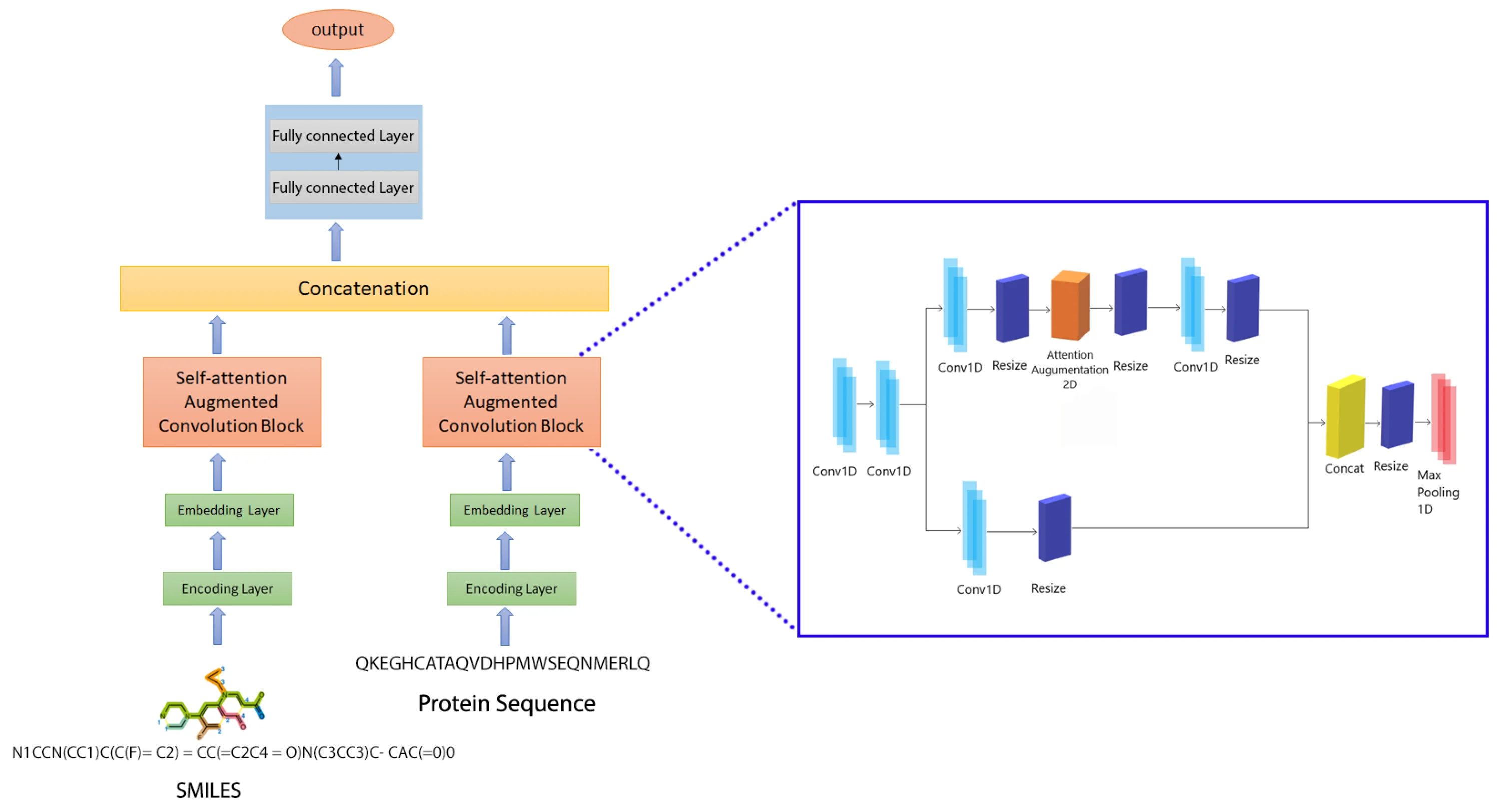
CSatDTA: Drug-Target Affinity Prediction
Challenge: Early-stage drug discovery needs sequence-based methods that capture local and long-range interactions in molecular and protein sequences.
Build: Developed CSatDTA, a convolutional self-attention model for drug and target sequence affinity prediction.
Impact: The IJMS paper reports that CSatDTA outperforms previous sequence-based approaches on benchmark datasets.
PythonTensorFlowKerasCNNsSelf-AttentionTFRecord
Publications
Peer-reviewed credibility behind the projects.
AI-enabled image processing approach for efficient clustering and identification of hardware Trojans
Ashutosh Ghimire, Mohammed Alkurdi, Saraju P. Mohanty, Fathi Amsaad
Hardware SecurityAISide-ChannelImage Processing
Featured
Open
Adversarial Attack Resilient ML-Assisted Golden Free Approach for Hardware Trojan Detection
Ashutosh Ghimire, Mohammed Alkurdi, Ghazal Ghajari, Mohammad Arif Hossain, Fathi Amsaad
Adversarial MLHardware SecurityTrustworthy AI
Featured
Open
D2H-AD: A Hybrid Model Utilizing Hyperdimensional Computing for Advanced Anomaly Detection
Ghazal Ghajari, Elaheh Ghajari, Ashutosh Ghimire, Saeid Ataei, Faris Alsulami, Fathi Amsaad
HDCAnomaly DetectionEdge AI
Featured
Open
A Golden-Free Unsupervised ML-Assisted Security Approach for Detection of IC Hardware Trojans
Ashutosh Ghimire, Mohammed Alkurdi, Md. Tauhidur Rahman, Saraju Mohanty, Fathi Amsaad
Hardware SecurityTrustworthy AIUnsupervised MLSide-Channel
Featured
Open
About
PhD with a software engineering backbone.
- RolePhD Candidate, CSE
- LabSMART Cybersecurity Research Lab
- LocationDayton / Fairborn, Ohio, USA
- Emailashutosh.ghimire@wright.edu
I'm a PhD candidate in Computer Science and Engineering at Wright State University, with three years of prior software engineering experience building production REST APIs, backend systems, and customer-facing applications.
That mix shows up in the work: I write reproducible Python ML pipelines, ship code that runs in batch on HPC, evaluate models under adversarial conditions, and communicate research clearly. Comfortable across the stack from FPGA side-channel measurements up to LLM-based explanation layers.
What I'm looking for: Industry research internships (Summer 2026 / 2027), applied scientist roles, and post-PhD positions where ML rigor meets real engineering constraints — security, healthcare, scientific computing, infrastructure.